Wednesday, April 29, 2015

The Hidden Politics of Video Games

Imagine that video games had been invented in the Middle Ages. From dawn to dusk, you have toiled in the fields for your master. Now, curled up next to the smoky fireplace of your flea-infested peasant hut, you turn on your 12th century Xbox and play your favorite game, Call of Chivalry.

Your back is sore and your belly is empty. But playing Call of Chivalry lets you escape into a virtual world where you are hero, not serf. Is your mission to free the oppressed from forced labor and starvation? No, in this game, you fight to uphold the divine right of kings. Your blade draws blood from rebels and rabble-rousers who would dare blaspheme the natural order by giving peasants the right to vote.

Monday, April 6, 2015

Finding the most impactful video games with a higher calling

Never-alone
In front of a smartphone, two players meet. They each grab half the device, preparing to play. But instead of a competitive matchup, they begin to rock and spin the phone, each holding their end of the phone tightly. In a few moments, through awkward giggles, they are twisting and spinning; the game forces them into a clumsy dance.
But mobile game Bounden isn't just about making players feel a little strange while pulling them outside their comfort zones. The unique game is also being honored by the Games for Change Awards (which highlights games that have a particular social impact) as an innovator when it comes to getting players to connect.
See also: Tapping Into the Emotional Side of Video Games: Developing Hope, Healing and Love
"Our digital lives are alienating us rather than connecting us," said Hsing Wei, awards director for Games for Change. "Bounden is seeking to use movement and use the form of play to get people outside their comfort zones and connect in a way that might translate to real life connections."
While Bounden has been honored quite a bit as an innovative mobile title since its May 2014 release, because it uses a smartphone's accelerometer to force partners to move together to complete puzzles, the Games for Change nomination connects that behavior to broader social implications. Wei points out that moving together can cross language and cultural barriers, and instill connections through that awkward intimacy.
The awards are part of the 12th annual Games for Change Festival, a New York-based gathering that focuses on how games can have larger impacts beyond gaming. The festival gathers game creators, researchers and humanitarians to share thoughts on how the medium can stretch beyond the simple ideas of play.
While many games typically associated with this movement focus on hard social issues like poverty, global conflicts or environmental issues, Wei said a game like Bounden can be just as impactful, and its inclusion shows how the thinking behind "games for good" has evolved.
"Bounden touches on empathy and human connection and collaboration and communication, which can also being a traction point for stimulating change or solutions," she said. "As the field is maturing, games are starting to touch on softer personal issues too, like bullying, gender identity and mental health, alongside the traditional ones we've seen."
It's a trend that can be seen in many of the nominees. Other honorees include Skip a Beat, a game that uses a heart monitor as a controller and encourages players to control play by understanding what made their heart rate speed up, and slow down, and Zoo U, a title that helps children learn how to navigate social situations by developing emotional skills that will help in them in the real world.
Of course, the "traditional" social issues are still present this year, but wrapped in even more nuance. Also nominated is This War of Mine, a game that puts players in the shoes of civilians trying to survive as war breaks out in their own country. The game has been commercially and critically successful, and lauded as being sensitive to the plight of real-life refugees, while still creating an engaging game.
What makes a game for change?
The awards are broken down into three categories: "most significant impact," "best gameplay" and "most innovative." The distinctions are important, and play into the history of Games for Change as a movement and as an awards event. (You can see a full list of nominees here.)
Games judged on "most significant impact" had to set their own goals for what that was, and what change they wanted to effect, Wei said. These games had a specific outcome in mind when people played, whether it was for raising awareness or raising money.
The "most innovative" award, which Bounden is nominated for, honors games doing something completely new inside the space, or "even in terms of the type of content it's trying to bring into a Games for Change context," Wei said.
The "best gameplay" award, for which This War of Mine is nominated, was much more about awarding excellence for games that succeeded on more typical video game metrics.
"Gameplay is looking at the degree of polish and functionality and thematic execution and whether it actually playable enough," Wei said. "Is the game something that people would pass along?"
"This category also helped the main tension in our community for several years, especially at the beginning," said Games for Change president Asi Burak. "The main complaint was there was too much emphasis on the impact and the gameplay was lacking. We want to show excellence in both fields."
Sometimes games can succeed in two different award categories, at least in the judges' eyes. Never Alone, a game created by a developer working with a group of Alaskan Native people, is nominated for both awards. The game was an effort to tell a Inupiat (a Native Alaskan group) story from an authentic perspective, but it's also a cooperative game sold on many platforms.
Leading by example
Burak said the most important goal of the awards, and the conference itself, is to inspire more people to create games that fit into any of these spheres. When the awards were first created six years ago, there were very few games that fit this criteria.
"Many people told us there weren't enough games and there is no quality," he said. "Our argument was that it's a bit of a chicken and the egg problem, and if you don't expose and reward the games being done and create a space for the developers, then you might not encourage them enough."
This year, the awards saw more than 150 submissions, which Burak said parallels a bigger shift by the games industry into experimenting with games that cover broader ranges of topics. Last year, the Game Awards — a large, independent award show spun off of cable network Spike's own past ceremony — had an award honoring "games for change." It was won by Ubisoft's Valiant Hearts: The Great War, a game that took a more serious look at the events of World War I and offered players more historical context as they played.
"I hope to think that this is a good trend in the industry, that you have more young designers that want to say things about the world," Burak said. "This new generation looks at games as a tool of expression, and this is how they want to relay ideas."
This year's Games for Change Festival is April 21-25, with some events open to the public. The awards will be held April 22, and passes are still available for purchase.

Monday, March 9, 2015

My awesome trip through a free archive of 'classic' computer games


One of the best things about being a “millennial” is not having to care about anything that existed longer than five seconds ago. Hence the reason why I don’t know who Paul McCartney is and why I have no idea what I ate for breakfast yesterday. Also, if Nicki Minaj doesn’t tweet in the next thirty seconds I will assume she is dead. I’m perfectly “within the demographic”.

So when I found out that the Internet Archive had uploaded over 2,400 free “MS-DOS Games” to its collection, I said holy shit, look at the cute retro style of these things. It’s just like Minecraft if they made it even more retro and also 2D. It’s as if the creators of these “classic” games copied the style of 2011 indie hit Terraria, but like, made some of them adventures and some of them shooters.

Recently, the Guardian asked me to take a look through the collection and pick out my favourites. I cannot wait to give these games seven out of ten while shrugging apathetically. Let’s dig in.

This text parser game seems like a lo-fi ripoff of Middle Earth: Shadow of Mordor, a 3D hemo erotic gay orc dating simulator, possibly made by social justice warriors.

Although the software library claims this Lord of the Rings text game was made in 1987, it is clear to me that someone like Braid’s Jonathan Blow probably made it last year to maximise on retro aesthetic cred, perhaps using Twine, an open-source text game engine that it is now fashionable to hate.

Among Shadows of Mordor’s innovations is its impatience with the player. When you don’t input something, the game quite frankly gets on with it without you. This really appeals to the attention deficit part of me while also highlighting what’s wrong with games these days: the controller sits there waiting for your input to slice an orc’s bollocks off when it could just bloody well get on with it itself.
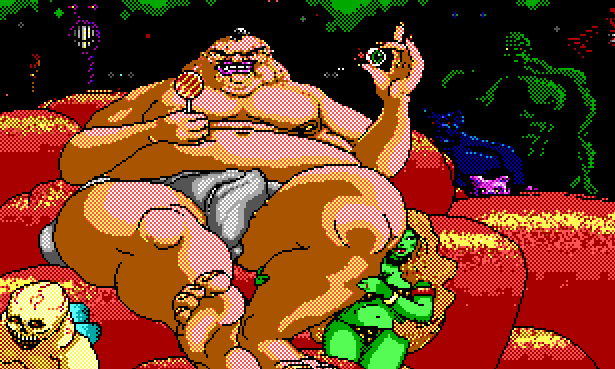
Tongue of the Fatman

This text adventure also doesn’t patronise the player with any “3D graphics”. Instead, it occasionally displays what looks like a Powerpoint slide of the “artist’s impressions” and the rest of the time you use the “graphics engine of the mind” to fill in Tolkien’s dullard hilltops full of short people.

Rating: I give this short attention span game at least ten selfies out of five Drake/Nicki Minaj fanfics. For you old people that is “quite good”.

PC Gamer called this crap, “certainly the worst [game] starring an overlord who Jabba the Hutt makes a point of forwarding his Weightwatchers pamphlets to when he’s finished laughing”.

Even ignoring the fat-based jokes, Tongue of the Fatman is a 1989 fighting game that is so poorly balanced and unresponsive that it is practically unplayable. You can bet on yourself to earn money and then upgrade yourself if you win, though winning seems unlikely.

However, as a millennial, what appeals to me is the amount of stuff in it. There are about a million exotic and pointless items to purchase to bosh your opponent over the head with, including needle claws, force fields and some sort of electro-balls. It’s exciting. We millennials never get to purchase things because some bankers took all the money.


This game concerns the protagonist, ‘Gewt Ningrich’, running about killing nice things like polar bears (with an uzi), seals (with a club), Greenpeace protesters (with a battleship-mounted gun), and the internet (with some sort of… forcefield?). It says 1997 on it, but that can’t be right because the target of this biting satire is a clueless conservative who hates seals and the internet, and those guys are still around.

In any case this game is very edgy because it is well known that gamers today do not want politics to appear anywhere in their games, so kudos to the developers for actually making a game that seems to try to make both rich old people and entitled young people feel alienated at the same time.


Since I began doing what an arsehole like me might call “travel games journalism”, people keep saying “Where In The World Is Cara Sandiego” to me as if it is a joke a millennial might get. I can finally state that no, I had never heard of Carmen Sandiego before you made the joke, because frankly I only give a shit about selfie sticks and weed.

In actuality, the 1985 detective game Where In The World Is Carmen Sandiego, a popular franchise created to teach geography to kids, is quite good. It’s a game of deduction and elimination, and is quite a bit more informative than infamous stabbings-through-history simulator Assassin’s Creed, which usually features only one exotic country at a time: this game boasts many countries. Also, you don’t have to do any stabbing to get to the next plot point, suiting my millennial impatience.

Controversially, Where In The World Is Carmen Sandiego stars a woman criminal traditionally depicted in a rather fetching wide-brimmed hat. Recent video games have shown an aversion to giving large narrative roles to women characters, and also a large aversion to giving protagonists such fetching hats. For these reasons, Where In The World Is Carmen Sandiego was probably a very polarising game back in 1985 and its hero was presumably the Rhianna of the era.

In any case, good work Carmen. Nice hat.


The last in my browser treasure trove is Floor 13, a Richard Branson-funded and sublimely understated turn-based spy game. We cannot really be sure it was not made by current indie darling Lucas Pope, designer of last year’s Papers, Please, but we’ll take the Internet Archive’s word it was made in 1992 by PSI Software Designers.

I suspect it may be more modern than it wants us to notice because in true millennial game designer fashion, it is extremely strident about how the Government Is Evil And Is Running The Media, whilst also entertaining goofy ideas about how probably everything is also run by the Illuminati and/or Total Dicks Who Harsh Everyone’s Buzz.

The idea is that you manipulate democracy so that you can stay in power, checking polls every turn to see how you’re doing. You can do this in a multitude of ways, through surveillance, searches, disinformation, intimidation and infiltration, all of which are little check boxes on a form that remind you how cold and uncomfortable the actual act of giving orders is.

The best thing about this game is that it neatly simulates the detached bureaucracy a totalitarian government would have to put in place to actually control things, making you increasingly aware that this might be why governments recruit such boring rich people.

Happily it does also make you aware that real life Britain would not be so perfectly controllable due to the belligerence of our arsehole citizens. For example, someone would definitely spray-paint a penis on your surveillance van and at least some of your establishment thugs would rather take a tea break or put a bet on a horse than go round and rough up a hoodie.

Actually, it’s quite good for a spreadsheet game.

Rating: I score it two Branson beards out of bangers and mash. You know, because it’s British.

You should check out the amazing yet slightly janky Internet Archive of MS-DOS Games for yourself before evil corporations who hate young people realise they can make actual money selling these products. Keep it dense, yeah? Peace and gaming.

Sunday, December 28, 2014

Non-online Computerized Games

The computerized version of the genre took off there were a lot of money hungry companies who decided to storm into the genre without really trying to understand what the vital elements of a role-playing game are. In order to sell role-playing games you need an audience willing to buy the product and if a company consistently puts out dodgy shooters in the guise of apparent role-playing games they'll only destroy their reputation and go bankrupt.

On that note, of the styles of role-playing games that include pen and paper, computerized games and online games, there is only one type that can meet the fully immersive needs of a role-player and I'll reveal why later. The worst of these are the recent thug games where one criminal organisation wants to defeat another criminal organisation and you're the hitman. Who is really that stupid to fall for such a terrible storyline? It's certainly not for intelligent role-players.
 This can be done cleverly by feeding snippets of information in a natural manner during conversations with non-player characters. Some extremely vital information can be revealed in otherwise meaningless banter, just like in the world you're immersed in right now. Making a major city that lies not ten miles from your current position something that you have to discover is ridiculous at best and only suits scenarios where you've been teleported into a new reality or you've lost your memory although the latter should be used sparingly as there are already too many games out there that rely on the character having amnesia. Discovery can be implemented in far more subtle ways by having secret areas within already well-known places and it is this that gives a role-player a sense of discovery.

Sure, the idea was novel but it was also very childish because it assumed that these two love interests were so enamoured with the player that neither could do without him. It was worse than watching Baywatch or Desperate Housewives. A real deal breaker for me is the inability to develop the type of character I want. I've encountered this more often than not in games where you have no choice over the skills that you character can develop. Of course, this is the worst scenario and there are many games that allow limited development but there are only a handful of games that allow a real sense of development.

The most annoying of these issues is a game where you can have a spell wielding character but they develop the exact same spells at exactly the same point in every run of the game. It's a little more forgivable for warrior types but even in this case there are many games which allow for dozens of different fighting styles. Non-online computerized games are the only games that allow for full immersion and I'll explain why.

Thursday, December 4, 2014

Do Computer Games Play an Important Role In Life?

Many have spent hours trying to tweak in-game graphical settings in order to increase the frame rate and boost the performance of their favorite games. However, in more case than not, those efforts award the player with only a slight improvement in overall game play. Game manufacturers assure us that their recommended specs should run the game smoothly. However those recommendations are calculated when the games are tested on PCs that were optimized for those particular games. There are very few who are willing to dedicate a whole computer specifically for a single game.

Many of the programs automatically start up when you log on to the net or at the moment Windows loads. Windows service programs can perform a host of operations from searching for updates, downloading, and even sharing applications with your games. The task is to cut down on the amount services running while your are playing the game in order to free up bandwidth and resources. They can cause game play lag and computer freezes by initiating a host of small applications and processes during game play. Turning these programs off during your game play is not entirely risk free but you will be amazed at the results by doing so. The entertainment industry saw video games increase at a galloping speed in the next few decades. In the world of technology and innovation, computer games have played an important role. Games include adventure games, action games, educational and knowledge games, simulations or role playing games, practice games, math games, logical games, and strategy and management games among other types.

However, still the market is one which has exponential growth and is still booming. With the help of computer simulations educational institutions support vocational and multi disciplinary learning, Moreover, the innocent children should not be misled to acts of aggression and violence as many of the video games depict. Parents need to pay tremendous attention that a video game should not affect their children's behavior and thinking in any adverse manner.